
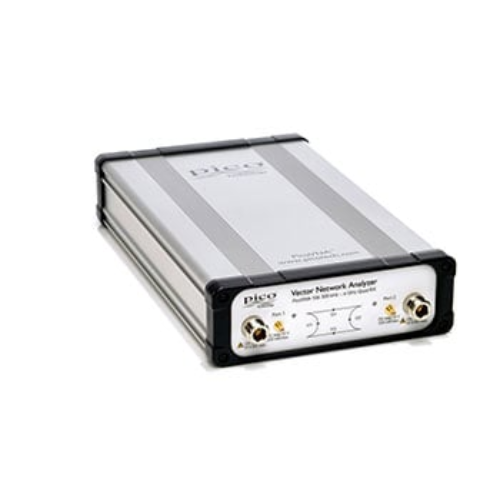
PicoVNA Series

Original price was: AED 2.00.AED 1.00Current price is: AED 1.00.
PicoVNA specifications
Standard conditions: 10 Hz resolution bandwidth, at 13 dBm (PicoVNA 106) or 0 dBm (PicoVNA 108) test power, at an ambient temperature of between 20 °C and 30 °C but within 1 °C of the calibration temperature and 60 minutes after power-up.
| Receiver characteristics | |||||||||
|---|---|---|---|---|---|---|---|---|---|
| Parameter | Value (PicoVNA 106) | Value (PicoVNA 108) | Conditions | ||||||
| Measurement bandwidth | 140 kHz, 70 kHz, 35 kHz, 15 kHz, 10 kHz, 5 kHz, 1 kHz, 500 Hz, 100 Hz, 50 Hz, 10 Hz | ||||||||
| Average displayed noise floor |
|
|
Relative to the test signal level set to maximum power after an S21 calibration. Ports terminated as during the isolation calibration step. |
||||||
| Dynamic range (click for graphs) | 0.3 MHz to 10 MHz 10 MHz to 6 GHz |
0.3 MHz to 10 MHz 0.3 MHz to 8.5 GHz |
10 Hz bandwidth Maximum test power: PicoVNA 106: +6 dBm PicoVNA 108: 0 dBm No averaging |
||||||
| Temperature stability, typical | 0.02 dB/°C for F < 4 GHz 0.04 dB/°C for F ≥ 4 GHz |
Measured after an S21 calibration | |||||||
| Trace noise, dB RMS |
|
201-point sweep covering 1 MHz to 6 GHz or 8.5 GHz. Test power set to 0 dBm. |
|||||||
| Spurious responses | –76 dBc typical, –70 dBc max. | The main spurious response occurs at close to (2 x RF + 1.3) or (3 x RF + 2.6) MHz, where RF is the test frequency in MHz. For example, when testing a bandpass filter with a centre frequency of, say 1900 MHz, an unwanted response will occur around 632.47 or 949.35 MHz. In all known cases the levels will be as stated. | |||||||


