
Choose the Right Type of Calibration for Your Instruments UAE
In a world driven by precision and performance, accurate measurement is not a luxury; it’s a necessity. From manufacturing and healthcare to oil & gas and energy sectors, every operation relies on precisely calibrated instruments to maintain product quality, safety, and compliance. But here’s a question many organizations often face: “What type of calibration is right for your instrument?” Choosing the correct calibration method can make a major difference in accuracy, cost, and compliance. This guide explores the different types of calibration, their significance, and how Arabcal, one of the leading ISO 17025 accredited calibration laboratories in the UAE, helps you make the right choice.
Understanding Calibration and Its Importance

Proper calibration is vital because:
- It ensures traceability to international standards.
- It improves measurement accuracy and product quality.
- It helps meet regulatory and ISO compliance requirements.
- It minimizes production losses and equipment downtime.
Regular calibration also enhances your reputation for quality and reliability, crucial in industries where even minor errors can lead to significant consequences.
Different Types of Calibration
The right type of calibration depends on your instrument, its application, and the level of precision required. Here are some of the most common calibration methods used across industries:
1. Mechanical Calibration
Mechanical calibration is performed for instruments that measure or apply physical dimensions, pressure, or torque. This includes tools like pressure gauges, torque wrenches, micrometers, and vernier calipers. It ensures that mechanical devices maintain their intended accuracy under varying physical conditions.
2. Electrical Calibration
Electrical calibration involves verifying instruments that measure electrical parameters such as voltage, current, resistance, frequency, and capacitance. Common devices include multimeters, oscilloscopes, and insulation testers. This type of calibration ensures accurate readings in power systems, automation processes, and electronic testing environments.
3. Thermal Calibration
Thermal calibration focuses on temperature-measuring instruments like thermocouples, RTDs, infrared thermometers, and temperature calibrators. Arabcal provides precise calibration services to ensure your temperature readings remain accurate across various ranges; vital for sectors such as food processing, HVAC, and healthcare.
4. Flow Calibration
Used to verify instruments that measure the flow of liquids or gases, such as turbine, electromagnetic, and ultrasonic flowmeters. Flow calibration ensures reliable and traceable flow measurements, essential for oil & gas, water treatment, and chemical processing applications.
5. Dimensional Calibration
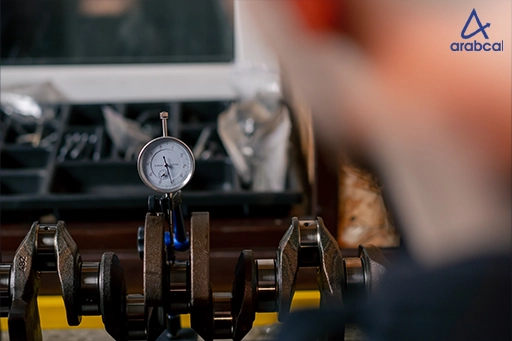
This type ensures that instruments used for dimensional measurements (like dial indicators, gauge blocks, and micrometers) remain accurate and within tolerance. It is crucial in industries like precision engineering and manufacturing.
6. Pressure Calibration
Pressure calibration ensures the accuracy of devices measuring gas or liquid pressure, such as pressure transmitters, transducers, and gauges. Arabcal uses traceable reference standards and high-accuracy deadweight testers to achieve reliable and repeatable pressure calibration results.
7. Biomedical Equipment Calibration
Medical and laboratory equipment like infusion pumps, patient monitors, and thermometers must be calibrated regularly to ensure patient safety and regulatory compliance. Arabcal’s biomedical calibration services meet stringent healthcare industry standards.
Factors to Consider When Choosing the Right Calibration
Selecting the correct calibration service depends on multiple factors, including the criticality of the measurement and the environment in which the instrument operates. Consider the following before making a decision:
- Type of Instrument: Electrical, mechanical, or biomedical instruments require specialized calibration setups.
- Operating Environment: Instruments used in high-pressure, offshore, or temperature-sensitive environments may need more frequent calibration.
- Required Accuracy: High-precision applications demand accredited laboratory calibration.
- Regulatory Compliance: ISO 17025 accreditation ensures calibration traceability and global acceptance.
- Calibration Frequency: The manufacturer’s recommendation and instrument usage determine how often calibration is needed.
By evaluating these parameters, organizations can maintain optimal instrument performance and reliability.
Arabcal: Your Trusted Partner in Precision Calibration
For more than three decades, Arabcal LLC has been a trusted name in calibration, validation, and instrument servicing in the UAE. With a state-of-the-art ISO 17025 accredited calibration laboratory, Arabcal offers a full spectrum of services across electrical, mechanical, thermal, pressure, flow, and biomedical parameters.
The company’s technical team includes factory-trained engineers and calibration specialists who ensure every process meets international traceability and quality standards. From onsite and offshore calibration to instrument rental, testing, and repair, Arabcal delivers end-to-end measurement solutions for industries that can’t afford uncertainty.
Why Choose Arabcal for Calibration in the UAE
- ISO 17025 Accredited Laboratory ensuring traceability and precision
- Wide calibration scope across multiple parameters
- Authorized partner for leading global brands
- Onsite and offshore calibration capabilities for flexible support
- Qualified engineers with decades of combined experience
- Comprehensive documentation including uncertainty reports and traceability records
Whether you need calibration for flowmeters, electrical testers, biomedical devices, or process instruments, Arabcal delivers accuracy you can trust every single time.
Authorized Service & Calibration Partner for Leading Global Brands
Arabcal’s reputation for excellence is further reinforced by its status as an Authorized Service and Calibration Center for several globally recognized brands, highlighting its commitment to quality and adherence to manufacturer-approved service standards.
In the UAE, Arabcal proudly serves as the authorized service center for brands including Megger, AFL, Hioki, Dillon, Snap-on, Anritsu, AFL, Phenix, Gentec, Barfield, Techcal, and Imada. In addition, Arabcal has recently been officially recognized as the Authorized Calibration & Service Center for Fluke in the UAE, ensuring that clients receive trusted, brand-certified calibration and repair services across a wide range of precision instruments.
This multi-brand authorization ensures all repairs and calibrations performed at Arabcal follow manufacturer-approved procedures, use genuine parts, and maintain factory-level accuracy. For clients, it means reliable service, extended equipment life, and guaranteed compliance with OEM specifications.
Ensuring Precision and Reliability with the Right Calibration Partner

With its ISO 17025 accreditation, multidisciplinary expertise, and authorized partnerships with leading brands like Fluke, Megger, DiLLON, AFL, etc., Arabcal continues to set industry standards for calibration and service excellence in the UAE.
When precision matters, choose Arabcal LLC, your trusted partner in calibration, validation, and measurement accuracy.